My Arduino Adventures began on Monday when I was introduced to Alex. His project involves the use of a light sensor to locate weeds. While my project will have a more aquatic application, our conversation was fruitful. He provided me with a starter kit and kind words of encouragement and off I went to write a "hello world" code, meaning making an LED blink, using my new Arduino "sketchbook". The sketchbook function is incredibly easy to use. Below is a code that I wrote... with much help from sample codes found online and a 50 page manual that Alex provided me with.
Writing code can be challenging, even for an electronics expert :). And more often then not there is an angry error message after you press the upload button. I know expect this message and welcome the kind words of advice that it provides.
Thats the programs way of saying "Please include a semicolon.. and Have a great day!"
Once you have all your semicolons in all the right spots, amazing things happen.
Like being able to have a series of LEDs blink at different rates.
(I apologize for the creepy/quite narration)
I learned many new things this week and look forward to new discoveries in the weeks to come.
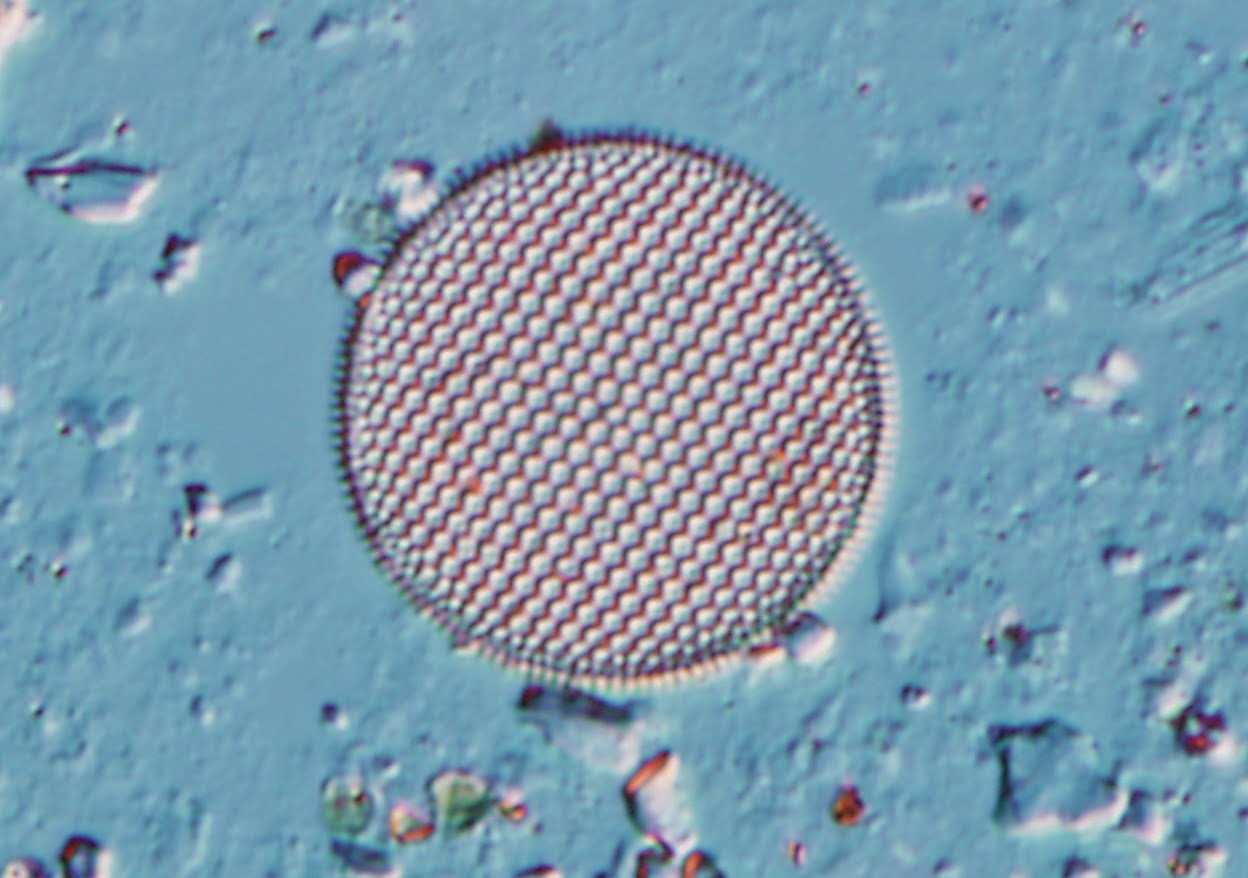
I spent my first week in the lab basically going through induction (lab safety and other protocol) and learning how to use Differential Interference Contrast (DIC) Microscopy. The optical physics are quite complex, but essentially it uses polarized light to create enhanced contrast and almost a three dimensional effect.
The following are some diatoms I photographed using a DIC microscope and a digital camera connected to computer software:
These were taken at 40X. Beautiful aren't they?? These were taken from prepared slides.
Today I went to some marine tanks on campus and learned to collect and prepare my own slides. I scraped a little sand off the bottom of a tank with some water in a vial and took it to a microscope.
I couldn't believe my eyes!! What appeared as ordinary salt water with a bit of sand was harboring a whole universe of swimming, twisting, moving, intricately shaped things! I saw tons of diatoms, as well as cyanobacteria, nematobes, and some microscopic shelled creatures.Beautiful!
Then I killed them.
I added a drop of Lugol's iodine soluiton and my universe stopped moving. The creatures were now fixed and preserved. I snapped some photos. Here's a lovely cyanobacteria. I took a picture using three different techniques: brightfield, darkfield, and DIC.
Brightfield (normal) microscopy
Darkfield microscopy
DIC microscopy
Pretty cool, huh? Still learning to identify all the diatoms and microalgae. More on that next week!
Katelin and I arrived at JCU in the dark on July 2. We both woke up at 4 am on July 3 and stayed in bed until 6 am. (We are in separate rooms, but oddly seem to be on the same sleep schedule!) I went out around 6:30 am and watched the sunrise. I was greeted by a cacophony of screeches and chirps. I attempted to capture some of the wild bird calls with my camera as you will see in the following video. You will also notice Mt. Stuart in the background, and some of the lovely hills that ring JCU campus.
Our dorm room is on the third floor of this building:
The campus architecture is mostly cinderblock construction, with lots of palm trees and covered walkways. In Australia it is common to find the indoors and outdoors mixed. Buildings may have open walkways through them, open out into the outdoors. Stairs and walkways are frequently outside.
Here are some shots of campus:
That last building is a dorm, where each room has a veranda, and many students have hammocks! I wish our room had a private veranda and hammock!
And everywhere you go, you see amazing birds. And hear them. Here are few of the common birds on campus:
Bush turkey:
Bush-turkey.
Bush turkeys are everywhere here. Very chill birds.
Below is the magpie-lark, also known as the peewee bird. Also very common here.
Magpie-lark.
These guys I see everywhere also... the bush-stone curlew. With those long legs it looks like a wader, but I only ever see it on land.
Bush-stone curlew.
Kookaburras are everywhere also!!! They will dive-bomb and take food right out of your hand, so you have to be careful when eating outside. Also they have a song that sounds like they are having a deep-belly laugh.
Kookaburra
Another bird that is about as common as the pigeon in New York is the lorikeet. They are considered a bit of a nuisance because they fly in large flocks and can be quite loud and annoying, and leave a lot of droppings in urban places. However, unlike the plain pigeon, the lorikeet is absolutely beautiful with a striking rainbow coloring. Here is a video I took of a bird on campus. You can also hear them crying in the background. (Much better video and pictures to come in our Maggie Island post.)
Cockatoos also fly in large flocks and are quite loud. I believe this is the bird that Jeff Wuebber described as waking him up every morning sounding like a baby being murdered. I tend to agree that the bird is quite obnoxious sounding, but they are a lovely sight. I haven't managed to get a good photo yet of one. But I will try to upload one soon.
Update: Cockatoo caught in action at Airlie Beach. See new picture below!
Cockatoo
Also, I would be remiss if I didn't point out that there are lots of wallabies on campus.
But getting good photos of them proves difficult. They are as common as deer, but usually run away when you approach. I'll try to upload some decent ones later. Update! Wallabies captured in film on JCU campus! See pictures below:
Finally, Australia is full of things that can kill you, or at least frighten you. I don't know if it bites, but this gal lives outside my lab, and I am not willing to find out.
I believe this species is Nephila edulis. We found her male partner (much smaller) nearby. The spider is called edible golden orb spider. One of several frightening spiders I have encountered here. There are also ants, everywhere, including our bathroom sink. Many trees harbor a type of red ant with a green abdomen, called green tree ants. I watched an Australian man eat some when his young son offered them as a snack. I asked my lab mates about this and they said that the green abdomens are edible and taste lemony due to the formic acid. I will have to try this delicacy sometime, for the sake of science.
Although we are spending many many hours in the laboratory helping with scientific discoveries and advancements in engineering, we have made time to explore outside of the lab.
This is a picture of our lovely accommodations thanks to Columbia University, CUSRP and Dr. Dubner (thats what Justine calls Jay)
Please note the sunshine, trees and greenery. They call this season WINTER.
Just beyond our dorms is a lovely running path along the Ross River. It most certainly feels like you are running in a rain forest. The bush turkeys try to race me, sometimes I let them win, because I don't want to make them angery.
This weekend Justine and I participated in some scientific data collection while hiking and snorkeling on Magnetic Island (Maggie).
Justine is very interested in the wild life and takes many pictures of birds each day.
(Bryan, does she do this at home?)
Here is a beautiful view of the water during one of our many hikes.
After our hike we stopped for dinner by the water. Justine spent most of the meal trying to identify the local birds.
One of my favorite parts was watching the sunset over the water.
We are well into week two "down under" and I just wanted to share some highlights
from the first week of scientific adventures in tropical Australia.
Above is the mighty science vessel that I myself did navigate during our mission to retrieve the water information collection devices. These devices are placed underwater to collect data on water turbidity, salinity and temperature among many other things. Below is a picture of a few of the devices that where pulled aboard, as well as the method used to retrieve the devices.
Drop the line in... hope to hook the device
Pull the line up... Guess we have to try again :(
And there they are! I wasn't able to get a picture of all the action while they were being hoisted out of the water and into the boat because I WAS STEERING THE BOAT. (Mom, don't worry I wore lots of sunscreen!)
Happy fourth of July to everyone back home! One week in the lab has proved to be eventful. The first email from the lab group was a request for me to accompany them on a mission out to the great barrier reef on a BOAT. I'm sure they realized my many boating skills and thought that I would be a useful crew member. The next email requested the name of my next of kin.... oh boy. Well I did survive the mission and although the reef is significantly closer than I had anticipated, it was a pretty crazy trip. On the drive out James, a member of my lab, asked if I knew how to swim. My mother had placed me in swimming lessons as a youth so a quickly replied OF COURSE! I followed with a plea of "please don't make me prove it." And so began a beautiful partnership.
Teacher scientists Justine McClellan and Katelin Corbett left their respective homes on 30 June at 4 pm EDT. Justine was hailing from the mainland north of New York City, from Westchester County, and Katelin from the glacial depositional feature from the last ice age, known as Long Island. The two sallied forth by automobile and arrived at John F. Kennedy Airport in Jamaica, Queens, at about 5 pm EDT. They arrived 2 hours prior to departure, to clear security and check baggage.
Flying Qantas Airlines from JFK to Los Angeles, the flight departed on time at about 7 pm EDT. Justine watched "The Kings Speech" and began reading a book on the race to break the 4-minute mile called The Perfect Mile. She thoroughly enjoyed both and took a brief nap during the flight. Katelin mostly slept, catching up on sleep she has sacrificed through weeks of teaching full-time, grading Regents exams, working on her PhD, and moving to a new apartment. The teacher-scientist was exhausted and took the opportunity to recover. Justine took the opportunity to steal some time doing non-scientific reading, a rare change for the always inquiring mind that is usually busy keeping up with the rapid advances in science. They were also fed dinner on the plane and given the finest of Australian wine.
The scientists arrived in the city of Los Angeles safely and had about a 2 hour layover until their midnight flight, that's midnight West Coast time, but 3 am EDT. After take-off they were served dinner and wine (again) and all parties promptly fell asleep. The flight from LA to Brisbane was about 14 hours. They were awoken at various times for snacks, and then breakfast. Justine did more reading and got about 150 pages read. They landed at 6:45 am local time in Brisbane on July 2. They boarded the plane on June 30, flew for 14 hours, and arrived July 2. Somehow a day was lost, much to the bewilderment of Justine.
They had to clear customs and collect their baggage and then take a bus from the international to the domestic terminal for their next flight on JetStar to Townsville. However their flight was not until 4:30 pm, and they were there by 9 am. Much to their consternation they were not even allowed to go through security to sit in the nicer restaurants and cafes. They had to console themselves with sitting by the baggage pick-up. Justine, who in addition to teaching the youth of Bronxville, and saving the Great Barrier Reef, is also training for a marathon in her free time, took the 9.5 hour layover to change in the bathroom and go for a 35 minute run around Brisbane airport. She enjoyed her first taste of the blazing Australian sun. Although Katelin was chilled by the wintery air and huddled with the luggage attempting to keep warm, Justine took respite in the warmth of the sun, amplified by the hole in the ozone. They ate lunch in the form of breakfast, very confused by the changing time zones and dates, and disrupted sleep schedule, unsure of what meal to eat when. Once through security and on to the nicer part of the airport they sampled more Australian wine in the attempts to blend with the locals in the fly-ridden terminal. Then on the plane for a two-hour flight to Townsville.
The young scientists arrived in Townsville around 7:30 pm, and gathered their bags and picked up their rental car. They activated the Australian GPS which Justine wisely packed, and was generously loaned by the much-esteemed Mr. Jay Dubner, the man who makes scientific dreams come true.
Katelin volunteered to drive. There was a brief moment of confusion as they realized that driver is positioned on the right-side of the vehicle, but they quickly over came that. Katelin did a swell job driving on the left-side of the road. Justine assisted by repeating over and over "Keep left!" They made it through various roundabouts without incident and were stopped briefly at a railroad crossing, where they spotted a white owl. The only problem was Katelin kept mixing up the windshield wiper with the turn-signal, and so they wiped their windows at nearly every turn.
Finally they arrived at James Cook University. They eventually found their dorm room and found a note left with keys to welcome them. Of course they were hungry and their cafeteria was closed, so they had to venture out once again to search for food. On their way they spotted their first wallabies, though at first they thought they were kangaroos, being unacquainted with the local fauna. After the wallaby-sighting, they quickly located the Woolworth's on campus. Yes, Woolworth's, the department store that went extinct in America, is alive and well in Australia, but is a grocery store. They loaded up on microwaveable food and cheese and crackers and yoghurt and other provisions and returned to the dorm and heated up their dinners. Finally a shower and some rest.
Justine's stopwatch stopped at 19 hours and 59 minutes, probably because the watch is meant for running and most people don't run for more than 20 hours. They put their total travel time at about 38 hours total from door to door. It was quite the epic adventure. And yet this is only the beginning! A sacrifice, but well worth the cost.